A Braver Australia
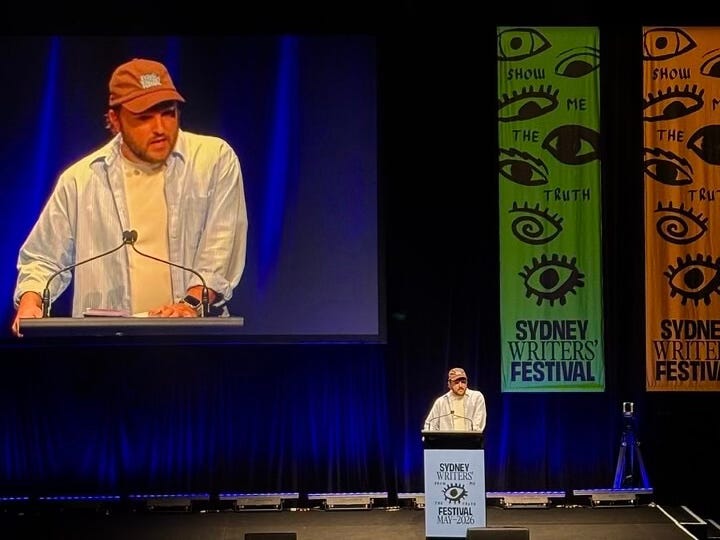
This is the [slightly trimmed] closing address I gave at Sydney Writers’ Festival 2026 last weekend (⊙_⊙)
I could feel something in my mouth, an uncomfortable taste. It started to make me cough and splutter. Some sort of gas or spray had been let off into the crowd, and panic began to set in at the Herzog rally at Town Hall Square.
They call it a square, but it really only has three sides you can leave from. Police had lined up shoulder to shoulder along George Street, another line across the steps down to Kent Street. Later, I saw footage of a police line literally chasing people down Bathurst Street. Those three streets are the three sides of this square.
So when the gas went off, a crowd of people who wanted nothing more than to get away from it found that the people supposedly there to keep them safe were holding them in place. I was lucky. I had my camera on my shoulder, and I passed the police line as ‘media’ without too much fuss. But most of the people inside had no idea what was happening or where they could go to get out safely.
I saw the police pulling people to the ground, punching people in the back of the head. One, two, three, five, nine times? Fists. Elbows. Knees. They pushed an elderly lady to the ground. She ended up in hospital that night with broken vertebrae…
The next morning, the premier stood in front of cameras and defended it all. He called it a “riot”. Said the short clips circulating online (of the police bashing his constituents) didn’t show the full context.
I was there. I had a camera. I saw the full context.
And then a few weeks ago, the NSW Court of Appeal struck down the laws used to justify that crackdown. Unanimously. Three judges found the laws were unconstitutional.
What. The. Fuck?
I shouldn’t swear; you’ve really got to be careful what you say these days. Some of us, at least. Because we have a media and a political class that will come down harder on an activist, an artist, an author for condemning state violence than they ever will on…say… a former prime minister who commends it.
A former prime minister who, as it happens, has been at this very festival, celebrating his latest work of fiction: Australia: A History.
He went on the radio the morning after the rally and said that the police deserved “a quiet commendation, not an investigation.” He wanted to see “tear gas and rubber bullets, if need be.” Because “these people”, he said, were “trying to intimidate the Australian community.”
We are the Australian community!
A few days after the rally, I was invited along to a healing ceremony at Addison Road Community Centre in Marrickville to try to shed some of the trauma that came from witnessing so much police brutality. We stood barefoot in a circle on the grass. There must have been more than a hundred of us. Strangers, mostly. Holding hands.
Auntie Lizzie, from the Blak Caucus, stood in the centre. Half joking, half not, she said something like: “Now you know what it’s like to be a Blackfulla. But for us, it’s every day.”
And she’s right. What we felt for one afternoon, the fists and the fear… for Aboriginal and Torres Strait Islander people has been the rule, not the exception, since the earliest days of colonisation. Of invasion.
We might not always be the target of state violence, but that doesn’t mean the state is on our side. It just means it hasn’t needed to turn on us yet.
The reality is that the political system of Australia, the institutions we’ve built, are founded on dispossession. On genocide. On incalculable harm. In contravention of the sovereignty of hundreds of clans and nations. We have to be honest about this.
It is a system built on exploitation. One that seeks to concentrate power, resource and wealth in the hands of the few, to the increasing exclusion of everyone else. It doesn’t really matter how many well-intentioned, good people work inside of this system, because, as the saying goes, “the purpose of a system is what it does.”
A Prime Minister can come from public housing. He can carry that story all the way to the top job. But when he reaches that position of power, his job becomes to protect the system itself. Not the people he came from.
Power and profit. Not people and planet.
But a system built on endless growth cannot survive in a finite world. It’s really just a matter of physics! The collapse of this system isn’t the end of the world. The collapse of our ecosystems will be. And this system—the one we’re in—will collapse either way, because ultimately it is designed to destroy the very conditions it depends on to exist.
That doesn’t mean I think we should burn parliaments and institutions to the ground. But it does mean we have to come to terms with what they’re capable of.
So what do we do? I don’t have all the answers. But I know where I’ve stopped looking.
We won’t get honesty from leaders who can’t call what is clearly a genocide a genocide. Who continue to approve new coal and gas when the science screams “PLEASE, LEAVE IT IN THE GROUND!” Who co-opt the language of the working class, then celebrate the cops bashing them in the streets. Who take selfies with rapists and racists and fascists (usually in the form of one particular President), then have the nerve to tell survivors they’re on their side.
I’ve been to the halls of parliament, I’ve genuinely looked there for solutions. And I found far more lobbyists and burned-out staffers than good ideas. The answers won’t be found there. But we have no choice but to find them somewhere.
We have to build new systems. Democracies where the “common people” truly rule. Systems capable of surviving within the bounds of our physical, social, ecological, psychological, biological, atmospheric reality.
And if collapse came tomorrow, I think you know what you’d do. You’d get your people together. You’d grab your neighbours. You’d pool what you had, and you’d try to keep each other safe.
Or maybe you’d get into a punch on in Woolies over toilet paper.
It remains that the answer to avoiding collapse and surviving collapse is the same. We just have the extraordinary, rapidly closing luxury of being able to build those systems now, while the lights are still on.
But the current system has a ‘solve’ for this: its most powerful and perverse tool is disconnection. It disconnects us from each other, from the land. From the consequences of what it does in our name. Because a disconnected people can’t build something different, something better. Where extraction is replaced with reciprocity. Where exploitation is replaced with empathy. Where harm is replaced with healing.
Then again, this way of life is nothing new. On this very continent, people have been living this way for 65,000 years, in reciprocity with each other and with the land. That knowledge survives, and is carried and shared by First Nations people from north to south and east to west. And we need only to listen and to act on what we learn.
And we can act anywhere. In circles. In community centres, libraries, parks, pubs, universities and school halls. In rooms like this one.
A braver Australia already exists. It’s being built every day by communities who can’t afford to wait for permission. By people who will never be invited to speak on a stage like this.
Disconnection is how this system survives. Reconnection is how we survive beyond it.
So go on. Sit in a circle, hold hands with a stranger, tell the truth to yourself, to others, to power. And live.


