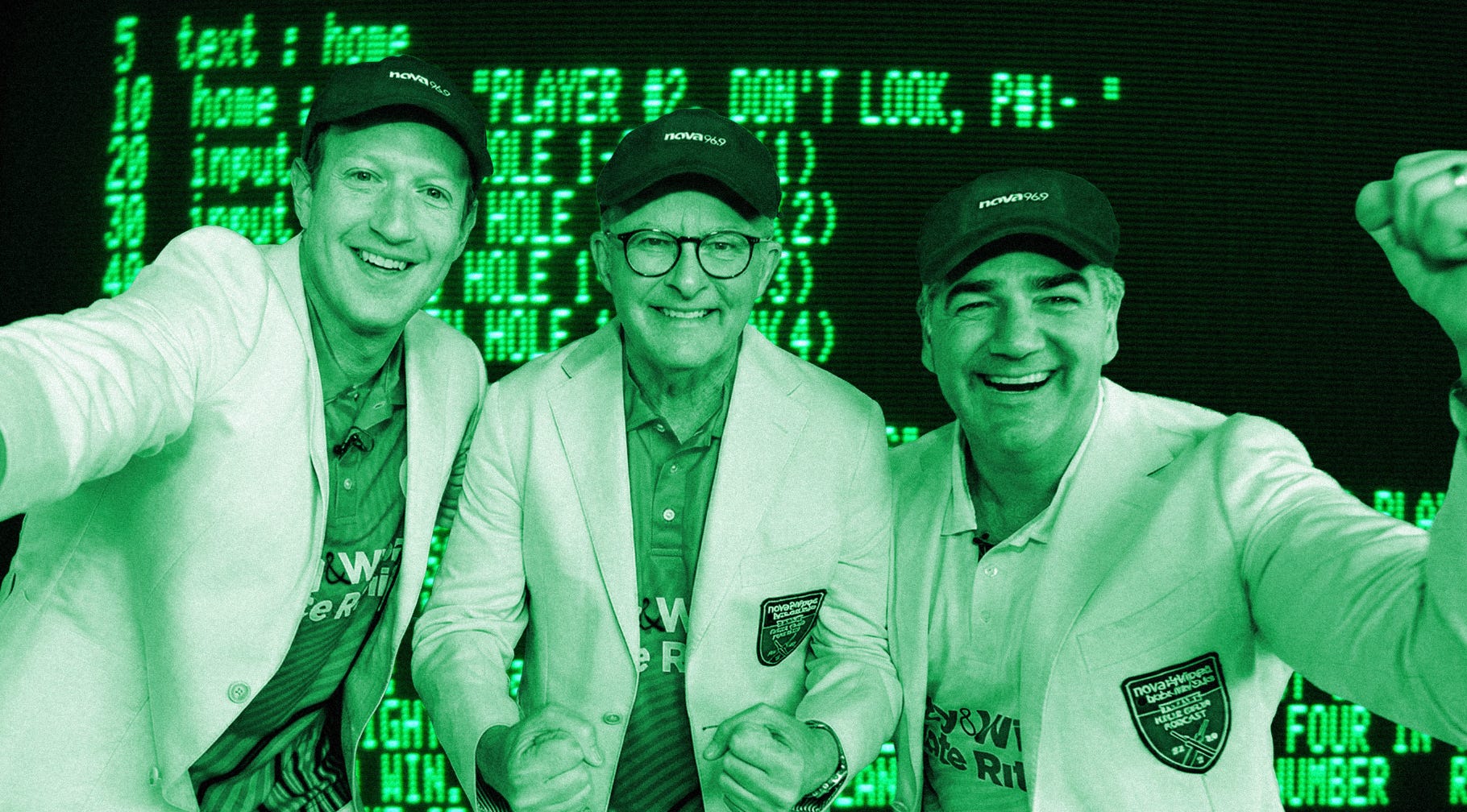
Ban-Easy. Regulation-Hardy.
The Albanese government took on children instead of taking on tech companies and...won?
So, here’s the tea. A handful of trillion-dollar multinational corporations wrote algorithms using the same behavioural science as pokie machines to hook billions of us to pocket mirrors with more compute than the machines that landed men on the moon. Their lines of code learn what makes each of us angry, afraid, and addicted, then flood our feeds with precisely that. The more we scroll, the more they profit, and it just so happens the easiest way to keep us scrolling is to make us all hate each other.
They built systems that mould lonely boys into misogynists, convince exhausted parents their kids’ vaccines are poison, boomers that 99.9% of climate scientists are lying, and entire populations that genocide is self-defence, actually.
Thankfully, the guy who answered “tropical bird” to the question “What is a pecan?” on Millionaire Hot Seat has a plan! And no, it’s not to regulate these companies, break their monopolies, or force any accountability whatsoever, but to ban anyone under 16 from using the apps. Then (and this is the genius bit) the government asks those very companies to enforce the ban themselves with tech that experts say has the structural integrity of soggy Weet-Bix.
At least they’re trying, right? At least they’re finally talking about how dangerous social media is. They cite the research, talk about addiction science, radicalisation, mental health freefall. They frame it as a threat serious enough to justify the most sweeping online restriction we’ve seen. Buuuuuuut they’re content to let the apps keep frying the rest of our brains. Why take on the powerful perpetrator of harm when you can punish a small portion of the victims instead? It’s genius if you [don’t] think about it.
The platforms are toxic, but they don’t have to be. They are harmful, but they are also helpful. Some kids, marginalised kids, queer, neurodivergent, isolated, abused, rely on these spaces as their only lifeline. A ban doesn’t protect them. It severs the line, pushing them into darker, unmoderated corners where predators wait.
And it undermines the important digital literacy we should be teaching. Instead of helping young people navigate online spaces critically, we’re locking them out until they’re 16, then throwing them in the deep end without having taught them how to at least tread water. Obviously, the algorithm doesn’t suddenly stop being cooked once you’re 16.
You’d think that would be obvious anyway…
Kids only got kicked off social media today, but it’s already a cliché: Australia, the land where a 10-year-old can be sent to prison, but a 15-year-old can’t be sent a TikTok. It’s the paternalistic approach politicians love because it makes them sound decisive without actually having to show any courage. As though telling some of the biggest dweebs ever to walk the earth, they “don’t get to manipulate people’s psychological vulnerabilities for profit without consent” is a scary undertaking outside of the bounds of responsibility of some of the most highly paid politicians in the world.
It’s been so long since we’ve had a government willing to stand up for the public over the powerful that we’ve almost forgotten we’re allowed to demand it. But we can still demand actual regulation. The kind that doesn’t sound as tidy in a Fitzy & Wippa phoner but might actually protect us from this mass manipulation. The kind that treats tech companies like the profit-maxxing, democracy-eroding, brain-frying machines they are, instead of asking them nicely to ask us nicely if we’re old enough to be harmed by their apps.
You had a choice, Albo. Take on tech companies or take on kids. We’ll remember you sided with Zuck over actually giving a fuck.


