


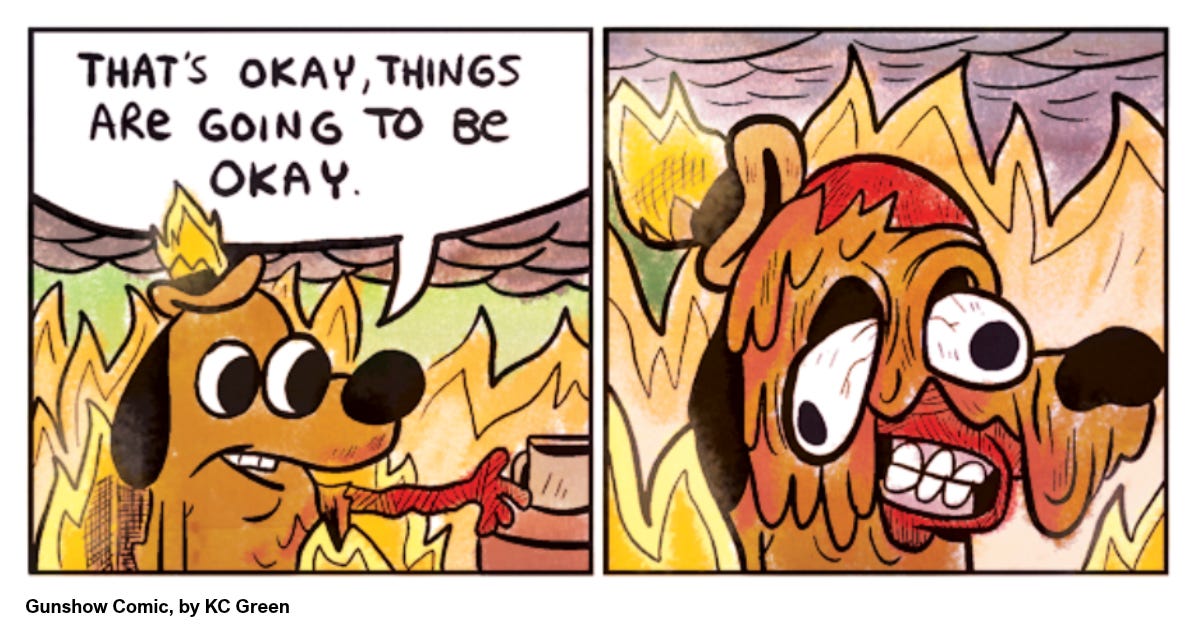
Aussies, did you hear? We fiiinally got our turn running the world’s climate talks, and guess what we did? We agreed to delete the words “fossil fuels” from a global climate agreement, and most of the world told us to get fucked…
It’s a farce so glaringly, ridiculously stupid that no analogy could ever do it justice. If anything, this should become the analogy. One day we’ll all say, “that’s almost as stupid as the time Türkiye and Australia couldn’t bring themselves to write ‘fossil fuels’ in a climate agreement”, and everyone will nod along, knowing exactly how monumentally dumb the thing in question is.
Anyway, it’s worth understanding exactly how that happened. Last Monday, the first draft called for “the immediate transition away from fossil fuels in energy systems”. Then came a few days of haggling with the other (っ◔◡◔)っ ♥ petrostates ♥, in a format I can only imagine looked and sounded a lot like a Jubilee debate (if the guy in the middle spent the whole episode furiously agreeing with everyone surrounding him). By Thursday, the draft had become a “transition towards low greenhouse gas emissions and climate-resilient development”. Then came two days of overtime, with around 130 countries demanding the words go back in. Spoiler: they didn’t.
Dumb... and depraved.
Had it passed, the final draft would have admitted for the first time what the science has made clear for years: we’re not gonna make it. Under 1.5°C, that is. You know, the line the world swore to avoid crossing because of all the death and destruction doing so would cause? We’ve blown the most important target in human history, and COP31 couldn’t even cop to it. Not that the climate cares. It’ll keep changing whether we admit it or not.
And the $120 billion a year to help poorer countries adapt? BACKSPACE BACKSPACE BACKSPACE. In its place, the draft added a push to accelerate carbon capture, a different kind of oil the fossil fuel industry likes to sell us: snake oil. It’s a decades-old “technology” that’s somehow also still in its infancy and ~showing great promise, just needs a little more time~. At best, it currently mops up about 0.1% of the world’s emissions. That’s more than nothing, but it’s a far cry from plants and soil at ~21%, the ocean at ~29%, or y’know not burning fossil fuels at all—which we actually already have the economically viable technology to do.
Chris Bowen, the Australian Climate Change and Energy Minister and THE FUCKING PRESIDENT OF NEGOTIATIONS, spent the summit browbeating everyone about how Australia, the world’s second-biggest exporter of fossil fuel emissions (behind only Russia), is the exemplar of a level-headed transition, one that gets the balance just right between protecting profit margins and protecting the environment. Hardly surprising from a government that came to office promising to “end the climate wars”, then approved 39 new, expanded or extended coal, oil and gas projects.
Déjà vu
I’ve written a fair bit about climate in my time. More than a third of my book Better Things Are Possible is dedicated to the problems we face and the work already underway to solve them. In the year and a bit since it came out, I’ve been asked about men’s mental health and the housing crisis more times than I can count (fair enough, both important), but specific opportunities to talk about climate? Almost never.
Last year, in the wake of COP30, I wrote about the world crossing 1.5°C, with barely a whimper from the media. The day before I published it, I counted the homepage stories across Australia’s major outlets and climate scraped into 4.3% of them. Yesterday, the day after the talks ended with Australia in the chair, I counted again, this time across eleven major homepages: 4.4%. Less than one story in twenty—on a day with more reason than most for climate to be the story, and even still, it was more stories about the negotiations “collapsing” than our climate. Interesting choice of words, huh? At 8.30 am yesterday, the ABC homepage had one story on the summit and two on Recipe of the Year. Suffice to say, Humanity’s Recipe for Disaster didn’t get the nod.
In that piece last year I wrote that “damage is unavoidable but collapse is not inevitable”. That—as I’ve come to accept since—was not true. We aren’t heading towards climate collapse, we’re already living through it.
But tell people the truth and they switch off. Tell them it’s going to be okay and you’re tucking them into bed with a fairytale. Damned if you do, damned if you don’t. But that damnation isn’t reserved for climate communicators, scientists and activists. We’re all damned. Those of us who’ve accepted it just have the painful privilege of grieving in real time. We have to mourn the trivial and the profound, everything from the ease of simply popping up to the shops to the sound of cicadas on a summer’s evening and the warble of magpies on a winter’s morning, knowing Mother Nature’s chorus is getting quieter every year.
What’s in a name?
Does anyone know what I mean? Is there a word to describe the feeling of mourning a way of life you know will be lost, while you’re still living it? Oh yes, a quick Google informs me that there is: solastalgia, coined by Aussie philosopher Glenn Albrecht. Sol-, from solacium, meaning comfort, and -algia, from algos, meaning pain. You can use it to describe the homesickness you might feel without ever leaving home. Planet Earth is my home. Yours too. And it’s the only planet in the universe we know of that’s home to intelligent life, and trees and rivers and platypuses and swimming pools and cinemas and... bowlos...
...
......
…
“Fuck it, let’s ball,” I say to myself as I order another pint I’ll pay for more than once. Whimsymaxx while you still can, Jack. Savour that half-cut Lime bike ride down Riley St under the jacarandas, life’s good. I can’t do anything until the people are ready to stand up alongside me, so I should just enjoy as much of life as I can, while I can. So I lighten up and take a shot every time I learn something dire.
Warming has nearly doubled its pace since 2015. Drink. A record-breaking super El Niño has pushed temperatures above 1.5°C month after month since August. Drink. And some projections have 2027 hitting 1.74°C. Drink. Warming has nearly doubled its pace since 2015. Drink. A record-breaking super El Niño has pushed temperatures above 1.5°C month after month since August. Drink. And some projections have 2027 hitting 1.74°C. Drink.
The world’s coral reefs are past the point of no return. Drink. Parts of the Amazon have already flipped from sequestering carbon to emitting it. Drink. And the Atlantic current that carries warm water north and keeps Europe’s winters mild is showing signs of slowing down. Drink. Greenland and West Antarctica’s ice sheets, which hold around ten metres of sea-level rise between them, are already melting, and risk going the same way unless we change course. Drink.
And after thirty years of summits, the world burned more fossil fuels last year than the year before. Drink. By one peer-reviewed estimate, every 0.1°C of extra warming costs around 100 million lives over the coming century. Drink. In Somalia, Kenya and Ethiopia, drought has left nearly one person for every Australian facing extreme hunger, and two for every Australian without clean water.
Dri... shots were a bad idea. We have to do something about this.
-algia
In September 2019 the 2030 deadline was more than ten years away, and ten years felt doable. Hope hung in the air as hundreds of thousands of us walked out of classrooms and offices and into the streets. Then summer came, and ash hung in the air instead. Sydney glowed orange for weeks, and babies took their first breaths as pack-a-day smokers.
We used to name our great bushfires after days of the week. Black Friday. Ash Wednesday. Black Saturday. Then a single day wasn’t big enough, so we named a whole season. Seven years after Black Summer, with this El Niño still loading up, what will we call the next one? Black Year? The disasters keep getting bigger while the crowds keep getting smaller.
But the mobilisation we need is bigger than anything we’ve ever mustered before, bigger than the Iraq war marches or the 2019 climate strikes. The scale needed is probably closer to a war effort. Around 127 million people were mobilised for World War II, between 5 and 6% of everyone alive. Whole societies reorganised themselves within months, for the purpose of killing. The same share of the world today would be around 450 million people—but this time we could be mobilised for life.
My book is subtitled How rebellious hope will change the world (my publisher picked that). I say the book is glued together by hope, but that doesn’t mean the pages don’t talk about how monumentally cooked we are. Some readers, by their own account, found that jarring. One reviewer said it was “a tough read” for a book “ostensibly about rebellious hope”. Another said they were “very stressed out and upset” by what they read. I understand that. I’m upset by what I wrote, too. And while I did my best to present as many solutions as I could find, looking back at a year of writers’ festivals and podcast interviews, invited as a poster boy for hope, I know now I was pulling my punches.
The jury is still out on what effective climate communication looks like, and I’m sure plenty of my fellow activists will disagree with the tone of this piece. But there are a couple of near-objective truths we should all be able to acknowledge. 1) What we’ve been doing to date hasn’t worked. 2) Our political, social and economic systems are not built for this moment.
But people are. We’ve survived plagues, famines, wars and an ice age (granted, that climate shifted over thousands of years, not decades), and I’m pretty sure that humans will outlast this global capitalist system of extraction and exploitation too. The question is how many of us make it, and what we bring with us.
Because you and I, your Uncle Bob and your Aunt Fanny, we’re the caretakers of this planet, and when the final full stop is inked on human history, a century or millennia from now, we’ll be remembered for what we did. Were we the generations that lived by “ignorance is bliss” right up to the bitter, war-torn, poverty-stricken, disaster-filled end? Or did we do everything we could to save every person and every living thing, and tear down that system that did so much harm to build one based on harmony instead?
Planet Earth is the only planet we know of that has bowlos. And we’re the only people who can save it. But at this rate, we’re not gonna make it.
Paul Gilding, ex Greenpeace exec, wrote a book, the title of which escapes me for the moment. In the book he posits that at some mythical point in the future, the entire world's population or at least the overwhelming majority, will all get together and fix the problem once and for all. He uses the analogy of the US, dragged screaming and kicking into WW2, as a middling economic power. By the end of the war, they had cornered the world's industrial activity.
He conveniently misses the point that by the time everyone's on board, the degradation will be irreversible.
I think we're beyond that point now.
🙌🏻🙌🏻